Overview
Set on the US Eastern seaboard in 2020, the film follows six fictional characters whose lives have been transformed by sea-level change and flooding in an urban and industrialized region on America’s North Atlantic Coast. Fictional testimonies are set against nonfictional accounts of actual deaths that occurred during Hurricane Sandy and other recent storms and floods.
Toxi•City is a combinatory narrative film that uses computer code to draw fragments from a database in changing configurations every time it is shown. As some stories seem to resolve, others unravel. Just as with ocean tides and tidal shores, the stories cycle and change without a clear beginning or end.
The work asks how conditions of life would change if repeated storm surges and tides flooded densely populated lands with toxins from sea-level petrochemical industry sites and post-industrial brownfields. Its narrative events draw on actual events and predicted conditions in the Delaware River Estuary and along the nearby coasts of New Jersey and New York.
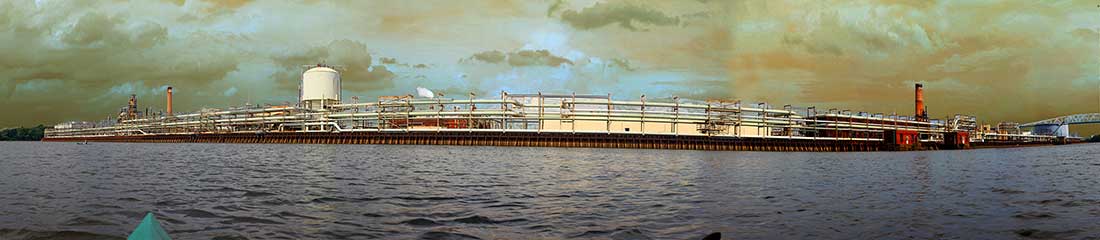
Panoramic stills from the project’s original image sequence and exhibition version.
Introduction
Viewers follow six fictional characters who live in a near-future landscape along the US eastern seaboard, one of the first industrialized port districts in North America and today home to five of its largest oil refineries. The project asks how conditions of life would change if repeated storm surges and tides flooded densely populated lands with toxins from sea-level petrochemical industry sites and post-industrial brownfields.
A combinatory film uses computer code to draw fragments from a database in changing configurations every time it is shown. As some stories seem to resolve, others unravel; individuals grasp for meaning from fleeting conditions of a world in flux. The project combines narrative elements with documentary imagery and elegiac nonfictional anecdotes, tying imagined futures to contemporary realities.
The inclusion of short fragments of real lives lost in recent storms grounds the speculative climate-change narrative. Because viewers never encounter the same configuration of stories twice, the structure reiterates the immense and distributed scale of loss that such disasters involve.
World and Characters
Setting
The film imagines a post-industrial shoreline in a near future time. Increased frequency of storms and rising tides have flooded active refineries, petrochemical plants, and brownfields, contaminating farms, residential communities, and natural preserves. A recent disaster at a coastal nuclear power plant has compounded the contamination of land and water.
Large areas of the lowlands of New Jersey have been evacuated. Cancer rates and food-borne disease have increased, yet life continues in an incrementally altered world where adaptation and compromised choice define everyday existence.
Characters
- A fisherman searching for new ways to survive in toxic waters.
- A young woman trying to escape the remnants of a failing civilization.
- A FEMA relief worker confronting needs beyond institutional capacity.
- A middle-aged woman working to build and sustain community.
- A pig farmer profiting from an atavistic economy emerging from disaster.
- A teenage boy coping with illness and a mother attached to the lost past.
Technical
The project draws upon more than 130 minutes of material. Each primary character speaks across roughly ten segments of about two minutes each, structured as beginnings, middles, and resolutions. These are interspersed with nonfictional anecdotes of actual storm deaths and musical interludes lasting roughly twenty to forty seconds, allowing for temporal variation and contextual framing.
The work can be programmed for shorter exhibition versions of around 30 minutes or for feature-length screenings of around 70 minutes. In cinema playback, no audience sees exactly the same film; in looping installations, each pass can also be weighted toward different character perspectives.
The original format was designed for three-monitor and panoramic cinema output at roughly a 5:1 ratio, but it adapts to immersive virtual reality environments, video walls, multi-monitor installations, 4K screening, and 3D media. The combinatory structure itself is coded in JavaScript to play through any HTML5 browser.
Imagery
The nonfiction segments layer documentary photography of estuary shorelines with portraits, maps, water flow, and pixel-altered animated elements. Many images were recorded during year-long kayak explorations of the Delaware Estuary and other industrialized shorelines threatened by sea-level rise and contamination. The imagery was developed in recursive collaboration with the text so that visual material could support multiple narrative fragments and enable recombinatory variation.
Production
Core team
- Roderick Coover, Director-Producer
- Scott Rettberg, Writer-Producer
- Joseph Kramer, Sound
- Mark Partridge, Sound
Supporters
- Chemical Heritage Foundation
- Temple University
- University of Bergen
- Brown University
- Electronic Visualization Lab at University of Illinois-Chicago
- Norwegian Research Council
Voice actors, narratives
Kamili Feelings, Alice Gatling, Dan Kearn, Marianne Rendon, Chris Monaco, Jason Marck
Voice actors, Hurricane Sandy stories
Aram Arghazarian, Don Anstock, Chris Whelan, Jeffrey Crousar, Darin Dunston, Saskia Hargrove, Cynthia Geonnotti, Steve Geonnotti, Richard Garella
Access
Toxi•City can be run live from the CDN Collection (requires a high-speed connection).
Script
Original production script of Toxi•City (2015) by Scott Rettberg.
Resources
- The Poetics of Combinatory Cinema: David Jhave Johnston interviews Roderick Coover and Scott Retttberg in Sound Effects 4.1.
- Situating Change: Combinatory Writing, Collaboration, and Technopolitical Reality published in Hyperrhiz 12.
- Altered Shorelines research project by Roderick Coover and collaborators on flooding coastlines in the US and UK and post-industrial toxic waste sites in the Delaware River Estuary.
- Review of Background Research published in Hidden City.
Video
Trailer / video sample (5:44).

Scott Rettberg and Roderick Coover present Toxi•City and other projects at Arts Santa Monica, Barcelona (1 hour).
YouTube currently blocks some embedded playback when a flat HTML file is opened locally from disk, so this version uses a direct watch link instead of a broken in-page player.
Recognition
Toxi•City was selected as winner of the 2016 SEA(S) Arts Award at the Ionian Center for the Arts and Culture in Kefalonia, Greece, and was exhibited in the museum in summer and fall 2016.

Official Selection, 2016 BIFF-EXPANDED, exhibition of works of expanded cinema, Bergen International Film Festival, Bergen, Norway.
Toxi•City premiered in its final, finished form in the exhibition Paraules Pixelades at the Arts Santa Monica Museum on the Ramblas in Barcelona, January to June 2016.
